Real-World Applications
Types of SaaS & web apps we engineer
Based in Lucknow with 16+ years of web and product engineering leadership under Kiran Mishra, we build custom web software across India for both emerging software startups and established brick-and-mortar businesses digitizing operations.
📊
B2B Micro-SaaS & Analytics
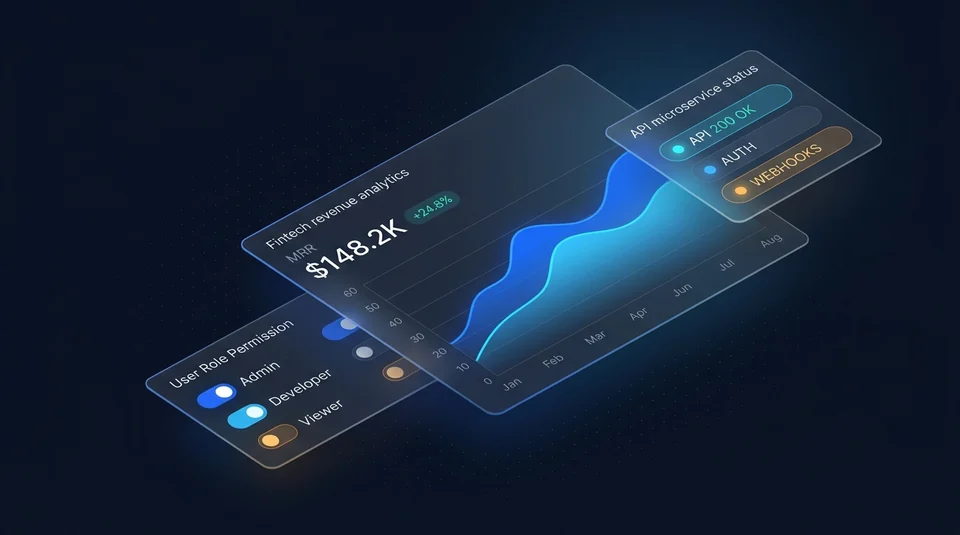
Niche subscription tools for GST billing, agency reporting, CRM tracking, WhatsApp campaign workflows, and automated document generation — engineered lean for rapid profitability.
🏥
Clinic, Lab & Healthcare Portals
Patient booking queues, doctor slot management, diagnostic PDF report portals, prescription archives, and WhatsApp reminder systems built for Lucknow and pan-India healthcare practices.
🎓
EdTech LMS & Coaching Portals
Student fee portals, mock test engines, attendance tracking, video batch gating, and automated fee receipts tailored for coaching institutes and training academies.
🤖
AI Workflow Wrappers & Copilots
Vertical AI products like our in-house Rasoi AI experience — combining structured prompts, credit-based usage metering, PDF ingestion, and clean user workspaces.
📦
Inventory & Dealer Portals
B2B distributor order portals, tiered wholesale pricing, GST credit notes, and multi-warehouse stock dashboards replacing slow spreadsheets and manual phone orders.
🔧
AI-Prototype Rescue & Hardening
Bought or generated screens via Bolt, Lovable, or Cursor that fail under auth or database edge cases? We audit vulnerabilities, fix SQL logic, wire real billing, and deploy reliably.
Technical Deep Dive
What founders overlook when scoping a SaaS MVP in India
Many promising software ideas lose six months of runway before onboarding their tenth customer — not because the core market thesis was wrong, but because the initial engineering build solved low-priority cosmetic details while ignoring production fundamentals. Over 16+ years building web systems from Lucknow for startups and regional SMEs across India, GoPixel has distilled SaaS MVP scoping into clear non-negotiable engineering boundaries.
1. Authentication, Tenant Isolation & Session Security Come First
When a clinic chain, coaching network, or logistics distributor signs onto a B2B SaaS platform, every organization must stay hermetically sealed inside its own logical tenant. Mixing data rows across accounts due to a forgotten `WHERE organization_id = ?` clause destroys customer confidence overnight. At GoPixel, we enforce server-side session checks, workspace membership middleware, and PostgreSQL row-level scoping from day one so unauthorized access between workspaces is structurally prevented across API endpoints, webhooks, and file downloads.
Beyond database separation, teams frequently underestimate role hierarchies. An account owner expects to control billing cards and API keys while inviting sales executives, reception staff, or external accountants with strictly narrowed permissions. Designing normalized permission tables upfront saves costly full-schema rewrites when you move from single-user demos to multi-seat commercial retainers.
2. Subscription Billing, GST Invoices & Webhook Idempotency
Collecting payments in India involves nuances that generic US SaaS boilerplates miss completely. Domestic cards require e-mandates or recurring UPI AutoPay flows under RBI guidelines, B2B buyers frequently request GST tax invoices with HSN/SAC codes and optional GSTIN fields, and Indian SaaS founders often sell globally in USD simultaneously via Stripe or LemonSqueezy alongside INR via Razorpay or Cashfree.
Equally important is webhook resilience. Payment gateways occasionally retry notifications during temporary network blips or take several seconds to confirm bank settlements. If your billing handler grants credits twice on duplicate events or locks out a paying subscriber because a callback arrived out of order, support tickets pile up immediately. We build idempotent webhook processors backed by event logs so subscription status transitions — trial active, payment succeeded, grace period, canceled, or upgraded — always remain reconcilable against provider records.
3. Deciding Between Monolith Velocity and Over-Engineered Microservices
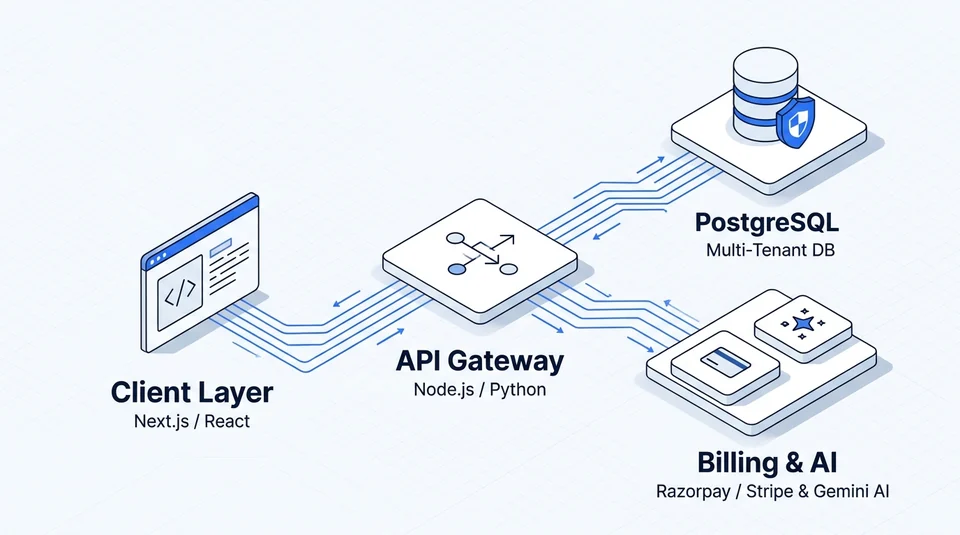
Early-stage founders are often sold unnecessary infrastructure complexity: seven separate Docker containers, Kafka brokers, and Kubernetes clusters for an application serving forty daily active users. Premature distribution slows deployment cycles, doubles cloud hosting bills, and introduces network debugging headaches. A clean modular monolith in Next.js + PostgreSQL + Redis queues handles tens of thousands of daily requests smoothly on modest VPS or managed cloud resources, keeping feature iteration fast while leaving clean internal boundaries to extract heavy jobs later if usage demands it.
Pre-Launch SaaS Engineering Readiness Checklist
Before kicking off code or requesting fixed-scope quotes from any custom web application company, walk through this six-point checklist with your co-founders or operations team:
✓
Core Job-to-be-Done Defined
Can a new subscriber sign up, complete the primary task, and observe tangible value in under five minutes without manual founder onboarding?
✓
Clear Tenant & Role Matrix
Have you listed exactly which screens an Admin, Team Member, Client Viewer, or Super-Admin needs during release version one?
✓
Pragmatic v1 Exclusions
Features like native iOS apps, custom drag-and-drop report builders, or multi-language localization can wait cleanly for v2 after paying traction proves demand.
✓
API & Cost Ceilings Verified
If your product calls LLMs (Gemini/OpenAI), WhatsApp APIs, or SMS OTP gateways, define per-tier credit caps before open signup goes live.
✓
Backup & Domain Hygiene
Automated daily database snapshots, staging-branch previews, and dedicated transactional email domains (SPF/DKIM/DMARC) belong in sprint one.
✓
Go-to-Market Foundation
Connect clean SEO landing pages, crisp brand identity assets, and automated trial onboarding emails before launch day.
Sample Architecture Scenarios Across Lucknow & India
01
Scenario: Replacing Excel Operations at a Multi-Branch Institute
Problem: Fee receipts, branch attendance, faculty schedules, and pending installments lived across disconnected spreadsheets shared over WhatsApp, causing reconciliation errors every month.
Solution: A custom multi-branch Next.js + PostgreSQL portal with branch-level RBAC, Razorpay fee links, automated WhatsApp/email receipts, and clean monthly export dashboards.
Outcome: Staff spend minutes generating fee registers instead of hours chasing cross-sheet formulas, while owners see live collection status cleanly.
02
Scenario: Launching a Subscription Micro-SaaS for Indian Agencies
Problem: An entrepreneur validated manual report preparation for twenty clients but could not hire analysts fast enough to scale without software.
Solution: Fixed-scope SaaS MVP Launchpad featuring OAuth login, automated third-party data ingestion queues, white-label PDF report generation, and tiered Razorpay recurring subscriptions.
Outcome: Self-serve customer onboarding replaced manual onboarding calls, allowing solo growth into recurring MRR.
FAQ
Frequently asked questions about SaaS development
How much does SaaS MVP development cost in India?
At GoPixel, fixed-scope SaaS MVP Launchpad builds start at ₹49,999 for 1 to 3 core workflows with authentication, PostgreSQL database, admin controls, and Razorpay or Stripe billing. Scaled multi-tenant SaaS products with RBAC, background queues, and AI API integration start at ₹99,999, while custom enterprise systems are quoted after discovery.
What tech stack do you use for custom web applications?
We primarily engineer SaaS products using Next.js, React, Tailwind CSS, TypeScript, Node.js or Python (FastAPI) APIs, PostgreSQL or Supabase, Redis caching and queues, and Cloudflare or cloud VPS deployment.
Do I get 100% ownership of the SaaS source code and IP?
Yes. Every client receives full Git repository ownership, database schema documentation, deployment scripts, and intellectual property rights with zero vendor lock-in.
Can you integrate Razorpay, Cashfree, or Stripe subscription billing?
Yes. We implement recurring plans, GST invoicing logic, trial periods, webhook verification, and customer portal upgrade or downgrade flows using Razorpay, Stripe, or Cashfree.
How long does it take to launch a working SaaS MVP?
A focused MVP with 1 to 3 core user workflows usually takes 3 to 5 weeks from architecture sign-off to production launch, depending on API integrations and UI complexity.
What is the difference between no-code prototypes and custom SaaS engineering?
No-code tools help validate mockups quickly, but custom engineering handles complex multi-tenant data isolation, custom business rules, third-party APIs, background jobs, and lower long-term hosting costs as users scale.
Can you rescue or scale an AI-generated or vibe-coded prototype?
Yes. Many founders approach us after building initial screens with AI coding assistants that break under authentication edge cases, billing webhooks, or concurrent queries. We audit, refactor security holes, and production-harden the codebase.
Do you provide post-launch maintenance and feature iterations?
Yes. Launchpad includes 60 days of post-launch support and Scaled SaaS includes 90 days of dedicated engineering support, after which teams can continue with an ongoing Website and Application Maintenance retainer.
Insights & Related Services
Everything else your SaaS launch needs
Explore complementary GoPixel services and in-depth technical guides written by our studio team.
UX
Interactive Figma flows and design systems engineered for intuitive onboarding and retention.
SEO
Rank your SaaS landing pages, comparison guides, and solution pages organically on Google.
EM
Automated trial-to-paid onboarding drips, product announcements, and churn-winback flows.
AMC
24/7 uptime monitoring, automated backups, security patches, and DevOps support after launch.
📖
Read our practical step-by-step playbook covering validation, Razorpay billing, and lean architecture.
📖
Understand where AI app generators break down in production and how to plan sustainably.